Reclaiming Biblical Ministry for Everyone in the Body of Christ to Serve, Teach, and Lead.
This trilogy explores how the early church’s model of mutual ministry can be restored today — empowering women, dismantling cultural barriers, and renewing biblical community.
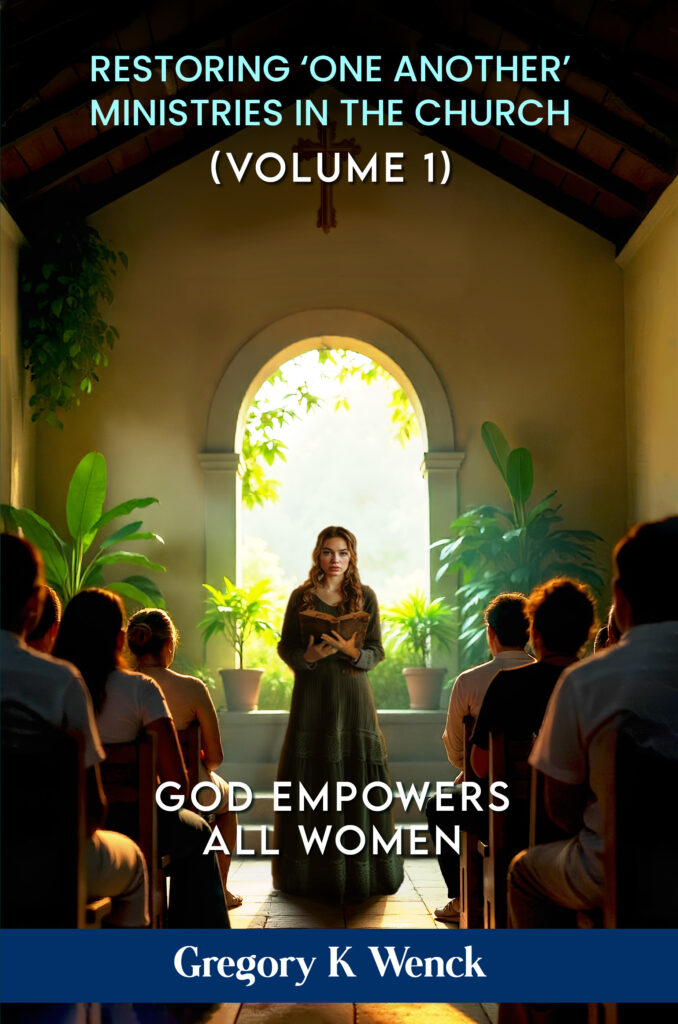
Scroll to read the summary:
- Biblical Foundations & Mutual Ministry: Early church model focused on teaching, serving, and encouraging each other.
- Empowering Women & Equality: God empowers women equally; all believers are called to contribute and lead spiritually.
- Cultural & Social Awareness: Understanding cultural ideologies and barriers affecting church community and leadership.
- Challenges of Male Headship: Highlights issues with hierarchical male-only leadership and the need for inclusive practices.
- Mutual Accountability & Spiritual Growth: Practical ways for believers to support, forgive, teach, and encourage one another.
- Practical Application & Resources: Study questions, exercises, and guidance for small groups and leaders to implement principles in real life.
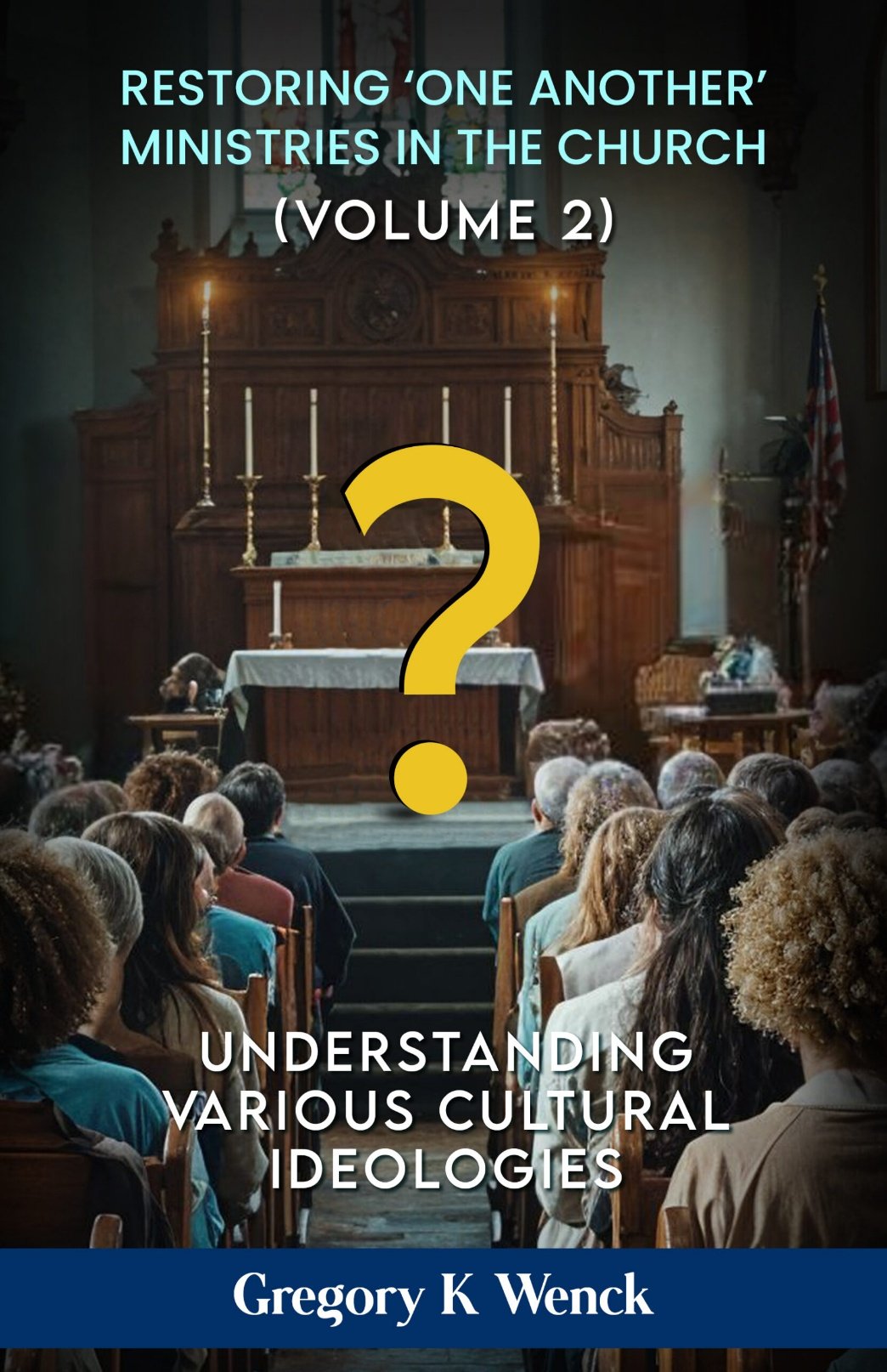
Scroll to read the summary:
- Preface & Executive Summary: Introduces the main themes and purpose of Volume Two.
- Challenges of Male Headship: Examines historical and cultural patriarchy, male-only leadership, and its impact on church and society.
- Patriarchal & Complementarian Ideologies: Analyzes flawed structures, misinterpretations, and societal influence on Christian practices.
- Matriarchy and Alternative Models: Explores empowering women, restoring equality, and inclusive leadership in faith communities.
- Mutual Ministry Principles: Practical guidance for “one another” accountability, spiritual growth, and restoring community within the church.
- Endnotes & References: Bibliography and research sources supporting the volume's teachings and insights.
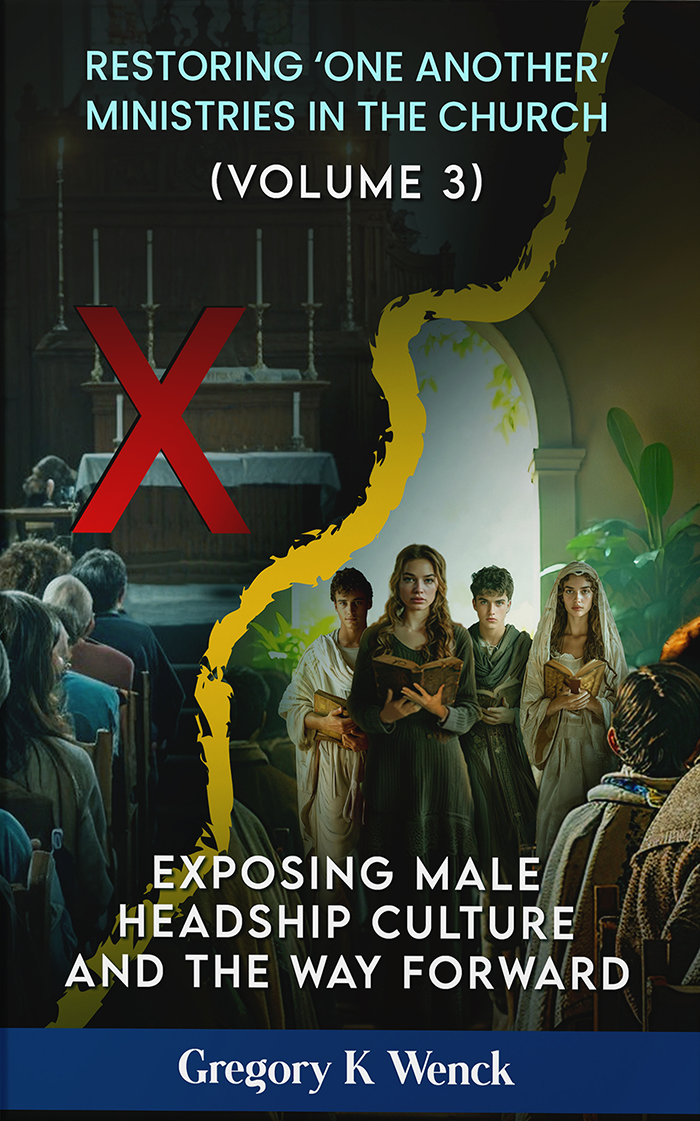
Scroll to read the summary:
- Introduction & Executive Summary: Overview of Volume Three themes and objectives.
- Hermeneutics & Biblical Interpretation: Understanding scripture to expose misused male headship interpretations.
- Exposing Male Headship Dogma: Historical and biblical analysis of patriarchal and hierarchical structures in the church.
- Recommendations for Change: Practical guidance for churches on collaborative leadership, empowerment, and mutual ministry.
- Spiritual Lessons & Best Practices: Five key lessons to ensure healthy, inclusive, and effective church structures.
- Endnotes & References: Supporting sources and bibliography for research and teaching.
Scroll to read more:
- Abstract
- Acknowledgments
- Executive Summary
- Tables
- Table A – The 100 NT Statements of ‘One Another’ are a Core NT Church Practice
- Table B – All Christians are Priests and Ministers as a Core NT Church Practice
- Table C – An illustration of Religious Belief Structures
- Table D – Understanding Relationships Between Root Causes and Causal Factors
- Table E – Background to Psychological, Social, and Emotional Issues
- Volume 1 - God Empowers All Women
- Volume 2 - Understanding Various Cultural Ideologies
- Volume 3 - Exposing Male Headship and The Way Forward
- List of Abbreviations
- Thesis Approach
- Methodology
- Focused Literature
- Descriptor and Belief Titles
- 0 Background and Context
- 0.1 God’s Caveat on The Eight Key Bible Themes
- 0.1.1 Love - Caveat on God’s Love
- 0.1.2 Unity - Caveat on Unity in God
- 0.1.3 Knowledge - Caveat on Spiritual Knowledge
- 0.1.4 Mind Renewal – Caveat to Renew Your Mind and Culture
- 0.1.5 Spirit – Caveat to Live in The Spirit
- 0.1.6 Gospel Mission - Caveat on God’s Gospel Mission
- 0.1.7 Hope - Caveat on Hope and Faith
- 0.1.8 Grace - Caveat on God’s Grace
- 0.2 Author’s Obligation to Be on the Guard
- 0.3 Background to Male Headship Versus One Another Ministries
- 0.4 Challenges for Change
- 0.5 Realizing Many Eminent Bible Scholars are Egalitarian Focused
- 0.6 Contrasting Male and Female Leadership in Secular Society
- 0.7 Male Headship and its Dysfunctional Impact on the World
- 0.8 Summarizing Problematic Issues of Androcentric Proof-text Verses
- 0.1 God’s Caveat on The Eight Key Bible Themes
- 1 Spiritual Equality, Inclusion, and Oneness
- 1.1 Creation Account is Equality and Oneness
- 1.2 Sin and Its Consequences in Genesis 3
- 1.3 Feminine Interactions in Jesus’ Life and Ministry
- 1.4 Feminine Intercession in the First-century Church
- 1.5 Gifts and Equality and Interconnection of Members of the Church
- 1.6 Mutual/Reciprocal Accountability – Brethren Carers Model
- 1.6.1 Mutual/Reciprocal Accountability Required of the Church’s in Rome
- 1.6.2 Instruct and Teach ‘Each Other’ is Mutual/Reciprocal Accountability
- 1.6.3 Encouraging and Building Up ‘Each Other’ is Mutual Accountability
- 1.6.4 Submit, Forgive, and Confess To ‘Each Other’ is Mutual Accountability
- 1.6.5 Decision-Making Between ‘Each Other’ is Mutual Accountability
- 1.6.6 Watching out For ‘Each Other’ is Mutual Accountability
- 1.6.7 Love ‘Each Other’ is Mutual Accountability
- 1.6.8 Living the Fruit of The Spirit is Mutual/Reciprocal Accountability
- Conclusions for Mutual Accountability to All Brethren
- 1.7 21 Declarations of Mutual Equality, Inclusion, and Oneness
- 1.7.1 God’s Declaration of Humankind is to Co-Rule
- 1.7.2 God’s Declaration is that Women Have Equal Authority to Men
- 1.7.3 God’s Declaration is that All Christians Are One in Christ
- 1.7.4 God’s Declaration is for All to Be Equal in the Great Commission
- 1.7.5 God’s Declaration is for All Disciples to Admonish Each Other
- 1.7.6 God’s Declaration is for All Women to be Spiritually Successful
- 1.7.7 God’s Declaration is that All Christians Are a Holy Priesthood
- 1.7.8 God’s Declaration is for All Disciples To Worship in Spirit and Truth
- 1.7.9 God’s Declaration is for All Disciples to Use Their Talents Always
- 1.7.10 God’s Declaration is for All Disciples to Teach/Instruct One Another
- 1.7.11 God’s Declaration is for All Disciples to Submit to Each Other
- 1.7.12 God’s Declaration is for All Disciples to Rebuke Each Other
- 1.7.13 God’s Declaration is for All Disciples to Love Each Other
- 1.7.14 God’s Declaration for Married Couples is Mutual Authority
- 1.7.15 God’s Declaration is to Renew Your Mind to God’s Will
- 1.7.16 God’s Declaration is for All Disciples to Serve Each Other
- 1.7.17 God’s Declaration to Recognize Equal Blessings for All Disciples
- 1.7.18 God’s Declaration About The Purpose of the Holy Spirit
- 1.7.19 God’s Declaration is to Respect, Protect and Reverence Women
- 1.7.20 God’s Declaration is That All Christians are Slaves For Christ
- 1.7.21 God’s Declaration is for All to Recognize Final Judgment
- 1.8 Realizing the Good in Various Feminist Movements
- Conclusions for A0I-1 - Validating God Empowers Women Equal to Men
- Endnotes (Bibliography and References)
Scroll to read more:
- Preface
- EXECUTIVE SUMMARY (Volume Two)
- Table A – The 100 NT Statements of ‘One Another’ are a Core NT Church Practice
- Table B – All Christians are Priests and Ministers as a Core NT Church Practice
- Table C – An illustration of Religious Belief Structures
- Table D – An illustration of Relationships Between Causal Factors to Root Causes
- Table E – Background to Psychological, Social, and Emotional Issues
- List of Abbreviations
- 2 MALE HEADSHIP DOGMA AND ASSOCIATED CULTURE
- Introduction
- Summary of Ancient Misogynous Cultures (Hebrew, Greek and Roman Culture)
- 2.1 Catholics and Protestants Nullified Feminine Intercession
- Misogyny Morphed into the Embryonic Catholic Movement
- Misogyny Further Morphed into the Protestant Movement
- Misogyny Normalized Through Patriarchal Ideology
- 2.2 Problematic Interpretation of the Greek Word Kephale
- 2.3 Extravagant Overreliance on the Use of Eisegesis, not Exegesis
- 2.4 Maleish Bias by various English Translations
- 2.5 Maleish Proof-texting of Certain Bible Verses
- 2.6 Over-Reliance on 12 Male Apostles
- 2.7 Men Rebelled Against Women’s Equality into the 20th-century
- 2.8 Androcentric Reliance on Male Headship Tradition Roles in Worship
- 2.9 Male Headship in the Church is Considered Spiritual Abuse
- 2.10 Shrinking Memberships, Church’s Closing Down and Sold Off
- 3 PATRIARCHAL IDEOLOGY
- Introduction
- 3.1 Patriarchy is Not a Worthy Christian Structure?
- 3.2 Examples of Flaws in Male Leaders Of Patriarchy Throughout the OT
- 3.3 Examples of Sinful Patriarchal Kings Throughout the OT
- 3.4 OT Examples of Sinful and Misogynous Priests, Prophets and Elders
- 3.6 Traditionalists, Conservatives and Fundamentalists
- 3.6.1 Traditionalists
- 3.6.2 Conservative - Conservatism
- 3.6.3 Fundamentalism
- 3.6.4 Restoration Movements
- 4 COMPLEMENTARIAN IDEOLOGY AND ASSOCIATED CULTURE
- What are the origin and problems of ‘complementarian dogma?
- Wrapping Up Complementarianism and Its Male Headship Ideology
- 5 MATRIARCHY AND ASSOCIATED CULTURE
- ENDNOTES (Bibliography and References)
Scroll to read more:
- Introduction
- EXECUTIVE SUMMARY (Volume 3)
- Table A – The 100 NT Statements of ‘One Another’ are a Core NT Church Practice
- Table B – All Christians are Priests and Ministers as a Core NT Church Practice
- Table C – An illustration of Religious Belief Structures
- Table D – An illustration of Relationships Between Causal Factors to Root Causes
- Table E – Background to Psychological, Social, and Emotional Issues
- 6 HERMENEUTICS
- 7 EXPOSING MALE HEADSHIP DOGMA
- Introduction to How Manmade – Male Tribal Traditions Evolved
- 7.1 The Ephesian Church
- 7.1a Exposing Male Hierarchy Ideology In Ephesians 4:11-13
- 7.1b Exposing Male Headship Ideology In Ephesians 5:21-33
- 7.1c Exposing Male Headship Ideology In I Timothy 2:1-15
- 7.1d Exposing Male Headship Ideology In The Pastoral Epistles
- 7.2 The Corinthian Church
- 7.2a Exposing Alpha Male Headship Ideology In 1 Corinthians 11:2-16
- 7.2b Exposing Male Headship Ideology In 1 Corinthians 14:34-35
- 7.3 Exposing Male Hierarchical Ideology
- 7.3a Exposing Male Hierarchical Ideology In Relation To 1 Peter 3:1-9
- 7.3b Exposing Male Headship Ideology In Colossians 3:12-20
- 7.4 Addressing The Red Herring Excuses of Male Headship Ideology
- 7.4.1 Did Males Have Any Significance in Being Created First From Dust?
- 7.4.2 Why Were The Twelve Apostles All Males?
- 7.4.3 Why Were There No Female Priests In The OT?
- 7.4.4 Is Worship In Houses, Public And In Private, Acceptable Worship?
- 7.4.5 Addressing Obscure OT Passages
- 7.4.6 Who Have Been The True Spiritual Stewards By Example?
- 7.4.7 Is Male Headship Dogma Acceptable, Or Is It Sin?
- 7.4.8 Exposing Jesus’ Subordination To God As A Type Of Male Headship
- 7.4.9 Women Cannot Teach Because Women Are Prone to Being Deceived
- 7.4.10 The Church was Patriarchal Structured and So Is This Cultural?
- 7.5…Wrapup In Exposing Male Headship Dogma and Moving On
- 8 RECOMMENDATIONS
- 8.1 Where to Now?
- 8.2 The Need For A Spiritual Health Check Survey in The Church
- 8.3 Realising Five Spiritual Lessons Learnt (LL) in Best Practice Structure for a Church
- First LL - Ensure An Appropriate Spiritual Church Structure is in Place
- Second LL - Ensure Collaborative Leadership and Empowerment by All
- Third LL - Live To Serve and Encourage One Another in the Assembly
- Fourth LL - Utilize All Talents in All Ministries
- Fifth LL - Rely on the Latest Data – Spiritual Truth
- 8.4 Understanding Critical Success Strategies
- 8.5 Understanding Deflection Tactics, Root Causes and Causal Factors To Sustain Change
- 8.6 Developing Applicable Surveys and Analysis To Sustain Change
- ENDNOTES (Bibliography and References)
Begin your journey toward restoring one another in the Church
This trilogy explores how the early church’s model of mutual ministry can be restored today — empowering women, dismantling cultural barriers, and renewing biblical community.